































ISLAMABAD (NNP) —
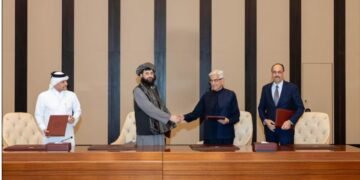
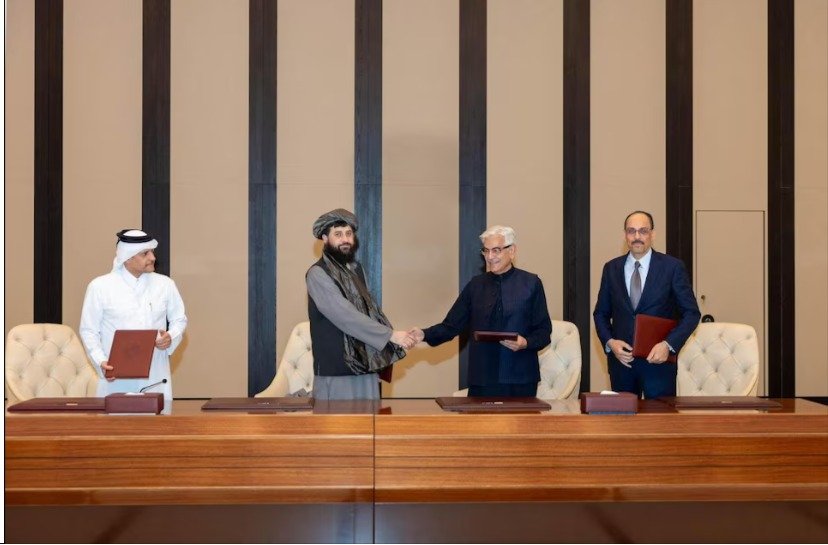
A major diplomatic breakthrough has been achieved as Afghanistan and Pakistan signed a comprehensive ceasefire agreement in Doha, Qatar, on October 19, 2025, after two days of high-level talks.
Afghanistan’s Minister of National Defense Mawlawi Mohammad Yaqoob Mujahid announced the deal during a press conference, describing it as a “permanent ceasefire” following one of the worst episodes of cross-border violence since the Taliban’s 2021 takeover.
The Afghanistan Pakistan ceasefire agreement was mediated by Qatar and Turkey and emphasizes mutual respect, non-interference, and peaceful coexistence between the neighboring nations.
Key Details of the Afghanistan Pakistan Ceasefire Agreement
- Venue and Duration: Talks were held in Doha on October 18–19, lasting about 13 hours.
- Delegations: Led by Mawlawi Mohammad Yaqoob Mujahid for Afghanistan and Defence Minister Khawaja Muhammad Asif for Pakistan.
- Core Commitments:
- Complete and meaningful ceasefire with no support for militant groups such as Tehreek-e-Taliban Pakistan (TTP).
- Ban on targeting security forces, civilians, or infrastructure.
- Reaffirmation of mutual respect and neighborly relations.
Afghan spokesman Zabihullah Mujahid confirmed optimism for continued dialogue, while both ministers thanked Qatar and Turkey for their mediation efforts.
From Clashes to Ceasefire
The ceasefire follows weeks of intense border clashes along the Durand Line, which left dozens dead and hundreds injured.
The escalation began after Pakistan’s airstrikes on TTP hideouts in Kabul and eastern Afghanistan on October 9–10, prompting retaliatory threats from the Taliban.
Despite a temporary 48-hour truce on October 16, fighting persisted until this permanent agreement was reached in Doha.
A follow-up round of technical talks will be held on October 25, 2025, in Istanbul, Turkey, to discuss implementation details.
Afghanistan–Pakistan Ceasefire Agreement
In the name of Allah, the Most Gracious, the Most Merciful
Considering the fact that Pakistan and Afghanistan are two brotherly Islamic countries, and both aim to establish peace, stability, and relations based on mutual respect in the region;
The parties (Pakistan and the Islamic Emirate of Afghanistan) mutually agree on the following matters:
Article 1: Border Peace and Stability
- Both countries agree that all types of firing or provocations in the border areas (Chaman, Torkham, Ghulam Khan) will be stopped immediately.
- A Joint Border Coordination Office will be established, which will maintain direct contact between the military officers of both countries.
Article 2: Cooperation against terrorism
- Afghanistan assures that it will not allow its territory to be used by any group that would carry out acts against Pakistan.
- Pakistan, in return for this assurance, will continue to cooperate with Afghan refugees in accordance with humanitarian and Islamic principles.
- Both countries agree to exchange information and possible action against Tehreek-e-Taliban Pakistan (TTP) and other non-state groups.
Article 3: Trade and People-to-People Relations
- A separate “Peace Corridor” will be established for trade at the Chaman and Torkham borders.
- A special pass system will be created for civilians, traders and patients to ensure safe movement.
Article 4: Media and Diplomatic Etiquette
- Official spokespersons and media organizations of both countries will refrain from making inflammatory statements against each other.
- Statements based on the principles of mutual respect and Islamic brotherhood will be preferred.
Article 5: Monitoring and Guarantee
- The State of Qatar will host and monitor this agreement.
- China and Iran support this agreement as guarantor countries.
- A Review Meeting will be held in Qatar every three months.
Article 6: Duration
This Agreement shall enter into force on the date of signature and shall remain in force for an initial period of two years.
This Agreement shall be automatically extended for a further period of two years if both Parties agree.
Regional and International Response
Diplomatic observers have praised the Afghanistan Pakistan ceasefire agreement as a rare moment of progress after years of strained ties.
Regional partners China and Iran—listed as guarantors—welcomed the accord, calling it a step toward regional stability.