
Astronomers Discover Oldest Known Quasar in Early Universe
Astronomers found a quasar dating back 13.1 billion years, 40 million years older than the previous record. National News Pakistan correspondents report that administrative desks and on-ground observers are closely monitoring developments across Pakistan.
60-Second Editorial Quick Summaryخلاصہ
Verified facts & intelligence briefed by National News Press Bureau.
Astronomers have made a groundbreaking discovery by identifying the oldest-known quasar, which formed over 13.1 billion years ago, just 630 million years after the Big Bang.
This quasar, named D n Aonghasa, is located in a galaxy's core and is powered by a supermassive black hole, showcasing the rapid development of cosmic structures in the early universe.
The quasar was detected by the European Space Agency's Euclid orbiting telescope and further analyzed using a combination of ground and space-based telescopes.
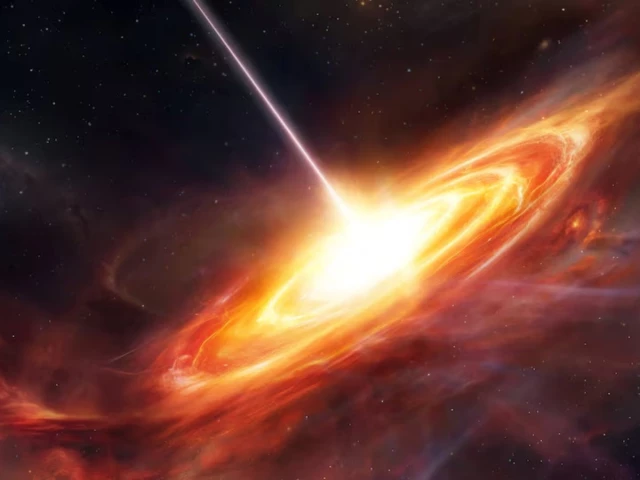
INTERNATIONAL BUREAU —known quasar, which formed over 13.1 billion years ago, just 630 million years after the Big Bang. This quasar, named D n Aonghasa, is located in a galaxy's core and is powered by a supermassive black hole, showcasing the rapid development of cosmic structures in the early universe.
The quasar was detected by the European Space Agency's Euclid orbiting telescope and further analyzed using a combination of ground and space-based telescopes. Julien Wolf, the lead author of the research published in Astronomy and Astrophysics, emphasized that this discovery adds to the evidence that some objects in the early universe developed remarkably quickly, with the black hole reaching a mass of about 360 million times that of the sun.
This finding is significant as it challenges previous understandings of black hole formation and growth in the early universe. The quasar's existence just 630 million years after the Big Bang suggests that the processes leading to the formation of supermassive black holes may have occurred much earlier than previously thought, prompting further investigation into the conditions of the early cosmos.
The discovery of D n Aonghasa not only enhances our understanding of black holes but also provides insights into the evolution of galaxies and the universe itself. As astronomers continue to study these ancient cosmic phenomena, they hope to unravel the mysteries surrounding the formation of the first stars and galaxies.
National News Press is committed to ongoing monitoring of astronomical discoveries and their implications for our understanding of the universe.
Key Takeaways & Executive Analysis
- Astronomers have made a groundbreaking discovery by identifying the oldest-known quasar, which formed over 13.1 billion years ago, just 630 million years after the Big Bang.
- This quasar, named D n Aonghasa, is located in a galaxy's core and is powered by a supermassive black hole, showcasing the rapid development of cosmic structures in the early universe.
- The quasar was detected by the European Space Agency's Euclid orbiting telescope and further analyzed using a combination of ground and space-based telescopes.
National News Press adheres to rigorous standards of accuracy, transparency, and independence. If you notice any factual discrepancy, please review our Editorial Policy or contact our desk at editorial@nationalnews.press.
Audience Reviews & Discussion
Share your perspective, rate coverage accuracy, and engage with verified readers across Pakistan.