
China's ageing villages play host to AI talent hubs
China turns sparsely populated areas into AI hubs to attract tech workers seeking quieter lives. National News Pakistan correspondents report that administrative desks and on-ground observers are closely monitoring developments across Pakistan.
60-Second Editorial Quick Summaryخلاصہ
Verified facts & intelligence briefed by National News Press Bureau.
In a sleek library next to wheat fields in Shanghai's farming suburbs, a dozen millennials work busily on laptops, many using AI, giving a welcome boost to this village of mostly retirees.
China's local authorities are rebranding sparsely populated localities as artificial intelligence talent hubs, offering quieter lives to mid-career tech workers seeking refuge from urban pressures.
In April, the town of Caojing -- in an idyllic nature reserve roughly 60 kilometres (40 miles) south of central Shanghai -- joined a list of places across China promising millions of yuan in subsidies for small-scale AI ventures.
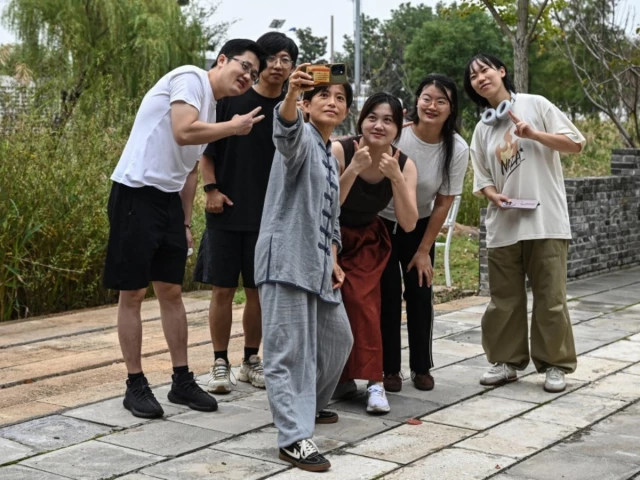
KARACHI BUREAU —In a sleek library next to wheat fields in Shanghai's farming suburbs, a dozen millennials work busily on laptops, many using AI, giving a welcome boost to this village of mostly retirees.
China's local authorities are rebranding sparsely populated localities as artificial intelligence talent hubs, offering quieter lives to mid-career tech workers seeking refuge from urban pressures. In April, the town of Caojing -- in an idyllic nature reserve roughly 60 kilometres (40 miles) south of central Shanghai -- joined a list of places across China promising millions of yuan in subsidies for small-scale AI ventures. Eligible start-ups who move there get free access to a shared office space, grants of up to 10,000 yuan ($1,500) and one month of free housing, the town has said.
Such hotspots are one outcome of Beijing's "AI Plus" policy blueprint, to incorporate the technology at virtually every level of learning and life. "AI is devouring everything," said 38-year-old Wind Liu, who moved with his wife to Caojing's Shuiku village three months earlier. They and around 30 other residents live in a few dorms converted from houses, in a digital nomad outpost billed as a community for AI-driven firms. Liu, an English teacher, uses the Chinese AI video generation tool Seedance to produce animated vocabulary lessons featuring characters from American TV shows he posts on social media.
I definitely need to have a relationship with technology," said Liu, wearing a "Think Less ChatGPT More" T-shirt. The village also offers him a respite from the non-stop "996" lifestyle in Chinese megacities -- a phrase describing 12 hour work shifts, six days a week. "Most people I've met here hope to get more freedom, with space, with time," he said. On a recent Monday, five roughly 30-somethings started the morning with a half-hour of Tai Chi in a light drizzle before splitting off to work.
Key Takeaways & Executive Analysis
- In a sleek library next to wheat fields in Shanghai's farming suburbs, a dozen millennials work busily on laptops, many using AI, giving a welcome boost to this village of mostly retirees.
- China's local authorities are rebranding sparsely populated localities as artificial intelligence talent hubs, offering quieter lives to mid-career tech workers seeking refuge from urban pressures.
- In April, the town of Caojing -- in an idyllic nature reserve roughly 60 kilometres (40 miles) south of central Shanghai -- joined a list of places across China promising millions of yuan in subsidies for small-scale AI ventures.
National News Press adheres to rigorous standards of accuracy, transparency, and independence. If you notice any factual discrepancy, please review our Editorial Policy or contact our desk at editorial@nationalnews.press.
Audience Reviews & Discussion
Share your perspective, rate coverage accuracy, and engage with verified readers across Pakistan.