
Current Account, when the banker needs it more than the customer?
By Yousuf Ibnul Hasan A current account is undoubtedly a useful banking facility. It serves businesses, traders, and individuals who require frequent deposits, withdrawals, and routine daily tr...
60-Second Editorial Quick Summaryخلاصہ
Verified facts & intelligence briefed by National News Press Bureau.
By Yousuf Ibnul Hasan A current account is undoubtedly a useful banking facility.
It serves businesses, traders, and individuals who require frequent deposits, withdrawals, and routine daily transactions.
There is nothing inherently wrong with a current account when it is opened out of genuine need.
KARACHI BUREAU —By Yousuf Ibnul Hasan
A current account is undoubtedly a useful banking facility. It serves businesses, traders, and individuals who require frequent deposits, withdrawals, and routine daily transactions. There is nothing inherently wrong with a current account when it is opened out of genuine need. The intriguing comedy begins when a customer has no use for one whatsoever, yet the local banker becomes convinced that the customer’s financial soul will remain eternally incomplete until he signs on the dotted line.
These days, opening current accounts feels less like a banking service and more like a high-stakes national mission. A customer walks into a branch to deposit a cheque, update basic information, or discuss business financing, only to encounter a manager who suddenly discovers a completely new life purpose for him. Somewhere between the reception desk and the inner office comes the warm, practiced suggestion: "Sir, why don’t you open a current account as well?" When the customer politely asks, "But why do I need one?", the initial reply is as illuminating as a turned-off lamp: "Sir, it will be very useful." Useful for what? After a brief, heavy silence comes the ultimate piece of institutional logic: "Sir, it is a banking facility." That settles everything except the original question.
This observation is not meant to unfairly criticize bankers. Bankers are essential professionals performing a vital economic function; banking simply cannot operate without deposits, risk management, and regulatory compliance. The goal here is to examine whether the modern banker-customer relationship is truly built on mutual benefit, or if it has morphed into a biased game where the bank wins every round and the customer learns the rules only after the match is underway.
If a customer already holds a savings account and does not engage in heavy commercial trading, why should he transfer his funds into a non-yielding current account merely to help the branch hit its monthly target? In an inflationary economy that quietly nibbles away at purchasing power like a mouse in a pantry, a customer naturally expects his hard-earned savings to work for him rather than sit idle.
Suppose a customer has Rs. 1 million idle. Left in a proper savings arrangement providing a permissible return, the money offers some defensive value. If he is persuaded to move that balance into a zero-return current account, who genuinely benefits? The bank secures a cheap, frictionless source of capital for its funding and investment desk. The customer receives the "convenience" of an account he never needed.
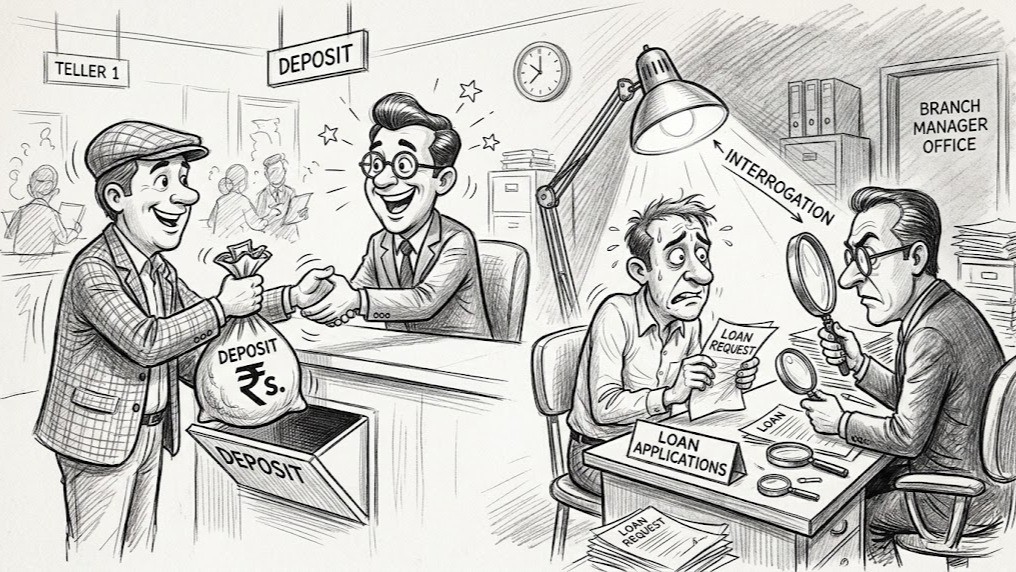
Consider the charming dialogue that unfolds:............ Banker: "Please keep your money with us." ....Customer: "Certainly." ....Banker: "Please maintain a healthy balance." .....Customer: "Of course."
Six months later, the customer returns to request financial assistance. Suddenly, the cozy warmth vanishes, and the tone transforms into a cold interrogation: .....Banker: "Please provide your financial statements, tax filings, asset valuations, income proof, security collateral, personal guarantees, and two-character references. Then wait for the credit committee." The confused customer quietly wonders, "When I brought you my money, you welcomed me like royalty and only asked for a signature. Now that I ask you to extend credit for a genuine business need, why have I suddenly become a matter of national security?" Naturally, banks have a solemn duty to assess credit risk rigorously; money cannot be handed out to anyone walking in with a winning smile. But there is a grand difference between prudent risk management and an institutional posture that treats every loan application like an unsolved crime.
A genuine banker asks: "What is the proposal? How will the funds be deployed? What is the cash flow? What is the risk, and how can we structure this safely?" That is banking. Merely opening a manual to recite prohibitions like an overzealous security guard is just administration.
"Relationship" has become the favorite buzzword in corporate banking. The manager insists, "Sir, we are giving you a relationship," while the customer thinks, "I just thought I was opening an account." A healthy relationship requires care from both sides. If one side cares only about low-cost deposits, fee income, and monthly targets, while the other seeks service, safety, and financial support, the relationship might be in desperate need of marriage counselling. The comedy deepens when monthly quotas enter the picture? The customer assumes the banker is recommending a tailormade product; the banker is actually staring at a deadline on his branch performance report. Both sit across the same desk, but they are reading from entirely different books. When told the account “Costs nothing to keep," the customer should remain watchful. Over time, minor ledger fees, debit card charges, statement costs, and administrative deductions begin to appear. Individually, they seem negligible, but collectively they act like a quiet leak in a water tank. Months later, the customer notices his balance has shrunk. When he calls, the bank politely explains: "Sir, those are routine service charges." The customer can only chuckle: "I appreciate the service; I just wish it were slightly less eager to help itself."
In modern finance, an old adage rings true: Depositing money is customer service; borrowing money is character verification. The customer who brings capital is greeted with warm tea; the customer who seeks credit is put under a spotlight. These dynamic highlights a fundamental imbalance. The bank manages thousands of accounts and spreads its risk across a broad portfolio. The individual customer cannot diversify so easily. For him, Rs. 500,000 or Rs. 10 million represents decades of sweat, family security, business reserves, or a cushion for retirement. To the bank, it is a small entry on a balance sheet; to the customer, it is his life's work.
From an ethical and economic perspective, capital should not remain frozen or idle without purpose. Wealth ought to circulate in productive trade, genuine enterprise, and real-economy investment. A current account itself is not unethical or un-Islamic—it remains a vital instrument for trade and daily operations. The subtle ethical issue arises when a customer is systematically pushed into leaving funds inactive in a zero-return account simply so the institution can gain an effortless financial advantage. If a customer genuinely requires a current account, by all means, let him open one. But if he does not, he should enjoy the unreserved freedom to decline without feeling like an uncooperative guest.
A mature banker is not disappointed when a customer turns down an unsuitable product; he is pleased that the customer understands his own financial position. The finest banker is not the one who opens the maximum number of accounts in a quarter. The finest banker is the one who says: "Sir, you don't actually need this product, so I won't recommend it." If that ever happened, a startled customer might look around the branch and ask, "Are you sure you work here?" Yet that single moment of honesty would build something far more durable than any monthly deposit target, “trust”.
The banker must be a trusted advisor before becoming a product salesperson. Customers do not need pitches memorized from a brochure; they need professionals who understand economic realities. The next time a friendly banker says, "Sir, you really should open a current account," there is no need to argue. Simply smile and ask: "Thank you. Please tell me why I need it." If there is a compelling business reason, open it. If the answer boils down to, "Sir, it is our branch target," you can smile back and reply: "I understand your target. But I also have a target to protect my money."
Key Takeaways & Executive Analysis
- By Yousuf Ibnul Hasan A current account is undoubtedly a useful banking facility.
- It serves businesses, traders, and individuals who require frequent deposits, withdrawals, and routine daily transactions.
- There is nothing inherently wrong with a current account when it is opened out of genuine need.
Audience Reviews & Discussion
Share your perspective, rate coverage accuracy, and engage with verified readers across Pakistan.