
PM Shehbaz highlights Pakistan's solar 'revolution by ordinary citizens' at COP31
Prime Minister Shehbaz Sharif on Wednesday highlighted Pakistan’s solar power boom at the COP31 in Turkiye, where world leaders gathered to discuss joint solutions to combat climate change. This year’s summit focuses on transitioning toward a low-carbon future. Delegates from nearly 200 countries are meeting in the Mediterranean resort city of Antalya as global greenhouse gas emissions...
60-Second Editorial Quick Summaryخلاصہ
Key verified facts & highlights prepared by the National News Pakistan Central Desk.
Prime Minister Shehbaz Sharif on Wednesday highlighted Pakistan’s solar power boom at the COP31 in Turkiye, where world leaders gathered to discuss joint solutions to combat climate change.
This year’s summit focuses on transitioning toward a low-carbon future.
Delegates from nearly 200 countries are meeting in the Mediterranean resort city of Antalya as global greenhouse gas emissions...
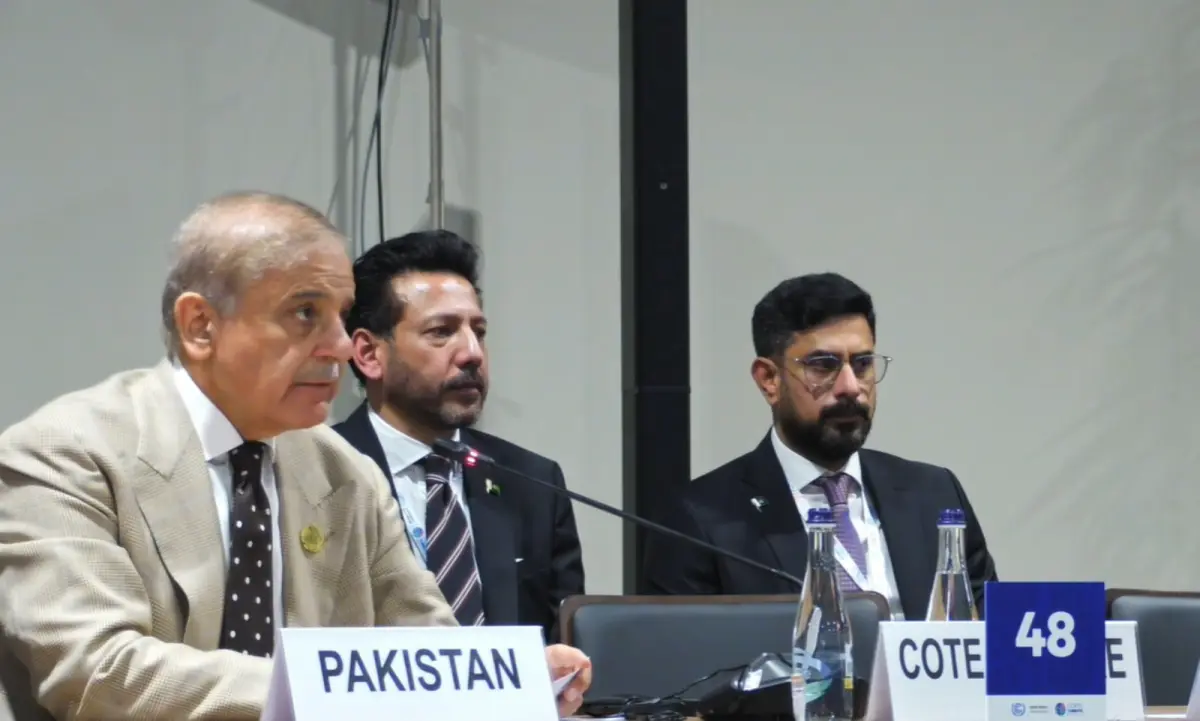
ISLAMABAD BUREAU —Prime Minister Shehbaz Sharif on Wednesday highlighted Pakistan’s solar power boom at the COP31 in Turkiye, where world leaders gathered to discuss joint solutions to combat climate change. This year’s summit focuses on transitioning toward a low-carbon future. Delegates from nearly 200 countries are meeting in the Mediterranean resort city of Antalya as global greenhouse gas emissions show little sign of falling and wars, inflation and other crises compete for political attention.
Addressing a high-level dialogue on clean energy transition, titled ‘ 35 by 35: Powering the Future ’, PM Shehbaz said : “In my country, an extraordinary transition has already taken place. “In just two years, Pakistan has added nearly 22 gigawatts of rooftop solar capacity — a quiet revolution by ordinary citizens seeking affordable power and a cleaner, more predictable future.” He affirmed that Pakistan fully supports the ‘ 35-by-35 Global Electrification Pledge ’, wherein countries agree to aim to increase electricity’s share of total final energy consumption to around 35 per cent by 2035 in line with global climate objectives.
The premier recalled the recent inauguration of a “key section” of Pakistan’s seventh nuclear power plant, Chashma-5, referring to its dome placement. He explained that the project will add 1,200 megawatts of clean energy to Pakistan’s energy mix. “A second transformation is now underway on our roads and highways.
Clean sources now provide nearly 55pc of our energy mix,” PM Shehbaz declared. The prime minister then highlighted that Pakistan’s newly drafted auto policy builds on the country’s aim to have 30pc of its new vehicles be electric by 2030 by offering “incentives for them through lower tariffs”. “All future government buses and motorcycles will be electric.
This year, for the first time, more than one in every 10 motorcycles sold in Pakistan was electric,” he stated. “The momentum is real and it is accelerating,” PM Shehbaz remarked, while cautioning that “momentum without finance cannot be sustained”. “Our grids must expand quickly and reliably. Storage must keep supply steady.
New technologies must be affordable for all. Yet, this burden falls on countries already under heavy debt,” he emphasised. The prime minister noted that Pakistan alone needs around $138 billion by 2035 for low-carbon power and $50 billion more to replace coal with solar. He stated that the ‘35 by 35’ clean energy goal could only be achieved “if finance flows at the speed of ambition through concessional capital and the transfer of affordable technology”. “Let us resolve to power our economies without impoverishing our people and light up our homes without darkening our planet.
That is the promise of 35 by 35, and it is a promise we must deliver together and under all circumstances,” the premier remarked. He thanked Turkiye President Recep Tayyip Erdogan, whose country has the COP31 presidency, for convening the “important dialogue”. Earlier in the day, PM Shehbaz was received by Erdogan and UN Secretary-General Antonio Guterres upon his arrival at the venue, the Prime Minister’s Office (PMO) said.
The premier and other world leaders then gathered for a group photograph at the summit. In his speech at the Antalya Leaders’ Summit, PM Shehbaz will highlight Pakistan’s climate priorities and emphasise the urgent need for enhanced global climate action and strengthened international cooperation to mitigate the adverse impacts of climate change, according to PMO.
The Foreign Office (FO) said the prime minister will also highlight “Pakistan’s steps towards rapid solarisation and expansion of its renewable energy capacity, as part of its transition towards a cleaner and more resilient economy, along with its efforts to strengthen disaster preparedness and early-warning systems”.
He will call for predictable, adequate and accessible climate finance for developing countries to strengthen their resilience and pursue sustainable development, it added. According to the PMO, a “Pakistan Pavilion” has been established at the COP31 venue where 54 events will be hosted on various themes.
Turkiye’s Erdogan highlights Gaza ‘ecocide’ Dozens of leaders were to speak during the “ high-level segment ” taking place on Wednesday and Thursday, including Erdogan, Iran’s President Masoud Pezeshkian and Brazilian President Luiz Inácio Lula da Silva, whose country hosted last year’s climate talks. “Nature — no less than people — is also paying a heavy price for armed conflicts.
The starkest example of this is Gaza… what has taken place in Gaza is not only a genocide, but it is also an ecocide,” Erdogan said to applause. Turkiye did not invite Israel to COP31, The Jerusalem Post reported . “As the host country for the leaders’ summit, we did not send an invitation to Israel,” it quoted Turkish Environment Minister Murat Kurum as saying. “Of course, we will discuss the climate and climate justice here.
We say that there can be no climate justice where peace does not prevail.” European Commission President Ursula von der Leyen, Chinese Vice President Han Zheng, and the United Kingdom’s PM Andy Burnham were also scheduled to speak on Wednesday. The United States, the world’s largest historical emitter, has skipped the talks for the second year in a row after President Donald Trump — who has called global warming a hoax — withdrew the US from climate cooperation following his return to office in 2025.
Negotiators from nearly 200 countries are seeking agreement on a plan to increase the share of electricity in global energy use and revive stalled efforts to move away from fossil fuels. As the third day began, the UN chief told world leaders at the summit that the slow international response to climate change so far had placed the world on a path to destruction.
Governments must fight harder to preserve the planet for future generations, he said, in comments that set the tone for two days of rapid-fire speeches by world leaders. “The brutal truth is that the climate crisis is outrunning us. This is the path to mutually assured destruction,” Guterres said, pointing to rising emissions, global temperatures and worsening climate-driven disasters. “But science is not telling us to surrender.
It is telling us to fight harder.” PM meets world leaders On the sidelines of the summit, the prime minister held conversations with leaders of various countries and international bodies. The premier and his delegation also had a separate meeting with Iran’s Pezeshkian and his team. The meeting was to “discuss bilateral relations and the promotion of mutual cooperation between Pakistan and Iran”, as well as the regional situation and matters related to regional peace, PMO stated.
PM Shehbaz, in a post on X, said he was “delighted to meet my brother”. While reaffirming the “deep and enduring bonds” between the two neighbours, the prime minister said he “conveyed Pakistan’s deep concern over the prolonged conflict in our region”. “Dialogue, restraint, de-escalation and sustained diplomacy are the only path to lasting peace,” he stressed. “Building on the understandings reached under the Islamabad MoU, Pakistan continues to play a sincere and constructive role for peace and stability in the region and beyond.” PM Shehbaz also met with Kuwait’s PM Ahmad Al-Abdullah Al-Ahmad Al-Sabah, with both leaders discussing the longstanding fraternal relations between their countries.
They “reaffirmed their resolve to further strengthen cooperation in a range of areas of mutual interest, including trade, investment, energy, development cooperation and people-to-people exchanges”, PMO said. The two premiers expressed the hope that the recent ratification of the Pak-Kuwait defence agreement would “further promote bilateral cooperation”.
They also exchanged views on international developments and challenges to regional peace. PM Shehbaz’s informal meetings included those with Bangladesh’s PM Tarique Rehman, Palestinian PM Mohammad Mustafa, Saudi Energy Minister Abdulaziz bin Salman Al Saud, Saudi State Minister for Foreign Affairs Adel bin Ahmed al-Jubeir and Syria’s President Ahmed al-Sharaa, according to PMO.
He also met Organisation of Islamic Cooperation chief Ismail Ould Cheikh Ahmed, World Bank President Ajay Banga and Türkiye’s First Lady Emine Erdoğan. In his conversation with his Palestinian counterpart, PM Shehbaz expressed Pakistan’s full solidarity with Palestinians. According to PMO, Mustafa thanked the government and people of Pakistan for “effectively raising their voices on the global level against the injustices inflicted on the Palestinian people and for supporting the Palestinian stance”. “During these cordial meetings, the prime minister and the world leaders discussed strengthening bilateral relations and the situation in the region,” PMO said.
It added that the meetings also stressed the importance of highlighting the challenges faced by countries most affected by climate change at the international level. Year of extreme weather A UN report last month found the world on course to break through the 1.5 degrees Celsius warming limit that countries had agreed to pursue under the Paris Agreement to prevent the worst effects of climate change.
Meanwhile, 2026 has also stood out with a series of extreme heatwaves across Western Europe and a glacier collapse in Nepal that triggered a catastrophic flood killing more than 1,450 people, with thousands still missing. Former French prime minister Laurent Fabius, who presided over the 2015 Paris climate conference and leads an advisory council of former COP presidents, said on Tuesday the leaders’ speeches should give political impetus to the negotiations. “It is an opportunity for leaders to make some announcements, and more this time, to explain how they will implement, because the key word in Antalya is implementation,” he told Reuters.
Several other nations, including France, Germany, Japan, Italy and Canada, did not send their top leaders to the talks this year and won’t be represented in the speeches. “The world’s biggest economies should be leading the response to the climate crisis, not leaving it to others,” said Mohamed Adow, director of climate and energy think tank Power Shift Africa.
Age of electricity? COP31 host Turkiye has been pushing for countries to put a goal on electrification at the centre of a final deal, though critics say it may do little to curb warming. The proposal targets a rise in electricity’s share of total global energy consumption to 35 per cent by 2035, up from a little over a fifth now, theoretically reducing greenhouse gas emissions from cars, factories and buildings.
But the proposal does not include language requiring new power to be generated by clean energy sources, and governments have yet to clarify a broader plan to transition away from fossil fuels like coal, oil and gas. Guterres urged countries to speed their transition to clean energy sources. He said the world’s dependence on fossil fuels was also damaging economies, not just the climate, an apparent nod to surging petroleum prices since the start of the US and Israeli war against Iran that has disrupted Middle East oil exports. “Three-quarters of humanity live in countries that import fossil fuels, hostage to price shocks they did not create and cannot control,” he said. “Recent conflicts make clear that this is a recipe for chronic insecurity and a cost-of-living meltdown.” ‘Difficult start’ Ahead of the conference, negotiators had been locked in discussions late on Sunday over demands by developing nations to include items on climate finance in the official agenda. “This has already been a difficult start for COP31,” said Jasper Inventor, head of Greenpeace’s COP31 delegation.
Under UN climate agreements, developed countries, which are historically responsible for most greenhouse gas emissions, have provided financial support to help developing nations adapt to climate impacts and transition to cleaner energy. But poorer countries say the sums remain insufficient. Inventor said developed countries were “taking a hard line” over whether to include a platform, agreed at COP30 in Brazil last year , aimed at discussing how wealthy nations should provide funds to developing nations.
African countries are also pushing for the agenda to include discussions on the tripling of adaptation finance, which aims to help poorer nations pay for measures such as building sea walls or planting drought-resistant crops. Observers say few major breakthroughs are expected at COP31 as countries grapple with an oil price shock and geopolitical tensions fuelled by the US war on Iran and Russia’s conflict in Ukraine.
Key Takeaways & Executive Analysis
- Prime Minister Shehbaz Sharif on Wednesday highlighted Pakistan’s solar power boom at the COP31 in Turkiye, where world leaders gathered to discuss joint solutions to combat climate change.
- This year’s summit focuses on transitioning toward a low-carbon future.
- Delegates from nearly 200 countries are meeting in the Mediterranean resort city of Antalya as global greenhouse gas emissions show little sign of falling and wars, inflation and other crises compete for political attention.
Audience Reviews & Discussion
Share your perspective, rate coverage accuracy, and engage with verified readers across Pakistan.